|
Play your way to motivation
|
|
|
Later this week, I’m running my “Meet Robot Kara” session live for the first time. (It will be recorded if you cannot attend live so sign up to get notified as soon as the recording is available). I doubt I’ll speak much about this in the workshop, but one of the biggest reasons I’m enjoying the work with the robot is that it feels like play.
In last week's newsletter, we talked about challenge calibration — finding that Goldilocks zone where a task is just hard enough to pull you in without shutting you down. But challenge level is only one piece of the motivation equation. The other piece is the orientation you bring to the work. And that’s where play comes in.
When most of us hear “play,” we think fun, games, maybe a little goofing off. But researchers who study this stuff have a much more specific definition. Bill Burnett and Dave Evans put it this way: “Play is about activity that brings joy just for the pure sake of the doing of it.” We’re not doing it to win or to hit a metric. We’re just doing it for the experience itself. As a person who likes to account for basically everything I do, just doing something for the fun of it is a delightful change of pace. It also means that a lot of what we think is play — competitive sports with a leaderboard, hobbies we’ve optimized to grow on social media, creative projects we’re grinding toward a goal — isn’t actually play at all. And a lot of things we dismiss as not serious enough actually are. The distinction isn’t what you’re doing. It’s the spirit you’re doing it in.
Another benefit of capturing opportunities for play is that play and stress are direct opposites. Most of us are swimming in an ocean of stress. But, it doesn’t have to be that way. Ali Abdaal identifies play as one of the most powerful energizers in his research on productivity and happiness — but he also names stress as the thing that kills it first: “If adventure and fun promote our ability to play, there’s a related, similarly potent factor that reduces that ability - stress.” Under sustained pressure, we don’t just stop having fun. We lose access to the experimental, risk-tolerant, willing-to-fail-and-try-again mindset that makes creative work and real engagement possible. Jane McGonigal calls that mindset being “gameful”. McGonigal argues that when we’re stuck, what we need isn’t more discipline or better systems. We need to bring the curiosity, openness, and optimism we naturally apply when we’re playing into whatever hard thing we’re facing. Not playing instead of working. Playing while working.
Anne-Laure Le Cunff’s Tiny Experiments is basically a whole book about how to do this. She suggests treating projects not as performances with outcomes to deliver, but as experiments. These are time-bound commitments (with yourself, usually) to try something without demanding a predetermined result. The internal shift is small, but for me it has been a real game-changer. Instead of asking “Is this good enough?” as measured by some external standard, I can ask “Is this interesting to me right now?” That second question is a play question. It puts you back in contact with what drew you to the work before the weight of outcomes moved in and took over.
So when something feels heavy and joyless — not because the challenge is miscalibrated, but because the whole thing has started to feel like a performance — try approaching it as play. Here are a few ideas gathered from research:
- Name it an experiment, not a task. Based on Anne-Laure Le Cunff’s work. Simple. Reword it in your head. “I’m going to experiment with this for 20 minutes” lands differently than “I need to finish this.”
- Ask “what would happen if…?” instead of “how do I do this right?” That’s the play question. Exploration mode vs. execution mode. This is how I’ve approached nearly all of the skills I’ve given the robot (now over 40!). What would happen if I asked the robot to…?
- Add a (potentially silly) self-imposed constraint. What if you did it in half the time? What if you could only use one tool? Constraints open up our creativity. They also raise the ceiling which we talked about in Part 1 of this mini-series.
- Give yourself permission to do a crappy version. This is now my primary way to approach nearly all first drafts. A crappy first draft removes issues of “failure” because it was intentionally crappy. While they rarely are failures, it doesn’t matter if whatever I produce is a failure. That was the whole intention anyway.
- Play together. Le Cunff calls this social flow. Playing alongside or with someone else completely changes the energy of a task. The great thing is you don’t even have to be working on the same thing. This is one of the reasons why The Facts of Life Book Power Hours are such a great way to get work done.
Where have you lost the play in something you used to love? Hit reply or come find me in Circle — I’d love to hear what you’re working on.
|
|
|
Some Other Things You Might Find Interesting
What I Published This Week
I worked with my video editor to prep the next video in the Task Management series. It — along with the article that accompanies it — should drop later this week! Thanks to the Robot, I hope to get back to weekly publishing by June!
What's Coming Up?
May 08, 2026 14:00
(Eastern Time (US & Canada))
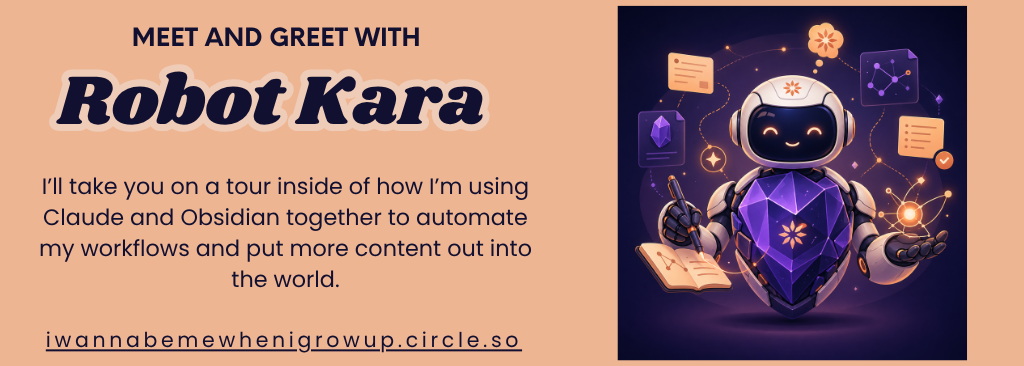
For the last couple of months, I have been building and fine tuning a Robot version of myself. Now I am ready for you to meet her.
Join me for this interactive session where you will get to see how I am using Claude, Wispr Flow, and Obsidian to automate many of my routine workflows and get back to the work that I love - writing and creating.
May 08, 2026 09:00
(Eastern Time (US & Canada))
Need to "get organized"? Avoiding making calls to doctors, lawyers, insurance, or others? Need to get prepared for taxes? Come join us for a Facts of Life Book Power Hour. Log on at the start time, declare your intention, and then I'll put on some music (breakout rooms will be available for those who prefer to work in silence) and we'll all work for about 50 minutes. At the end of the hour, celebrate your progress with others.
May 11, 2026 10:00
(Eastern Time (US & Canada))
Join us for the bi-weekly Obsidian Office Hours Session.
Office Hours are a time to ask questions about Obsidian. If you have a question, reply to the event with your questions - or attend live and you can get your question answered in the session.
When appropriate, office hours sessions will be recorded and the recording posted here.
May 11, 2026 09:00
(Eastern Time (US & Canada))
Do you want to get a better handle on your finances? If so, join me for a free one hour workshop to talk all things money. This is a great time to hold your own financial date with yourself (which I talk about in the Facts of Life Book Course). Get financial questions answered, see software tools like YNAB in action, or just chat about money. This is a judgment free zone so come with your questions.
Running Point
We wrapped up Season 2 of Running Point this week. Season 3 hasn’t officially been picked up as I type this, but they’ve set it up well for a 3rd season if it does get picked up. Season 2 saw Ray Romano join the cast as a recurring guest and a few good guest stars (Octavia Spencer & Nicole Richie) and guest spots and cameos by family and friends of the main cast as well as Jake from State Farm! If you don’t like a well placed F-bomb, this show isn’t for you. That said, otherwise it’s just good entertaining basketball adjacent humor.

|
|
|